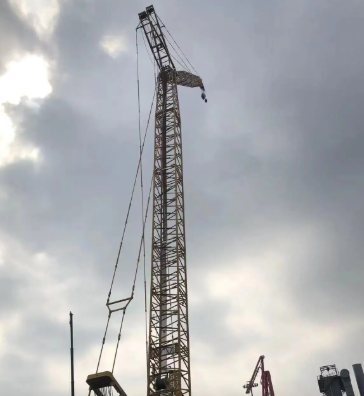
Crawler Cranes: The Engineering Pillar Conquering Muddy Construction Sites
In the realm of heavy lifting within infrastructure, energy, and rescue operations, challenging ground conditions are a primary obstacle. Saturated, soft, and unstable soils can halt progress for most equipment. However, the crawler crane is engineered to thrive in these very conditions. This specific crane type masters muddy sites not by brute force, but through intelligent design centered on managing ground pressure. The fundamental principle enabling this crane's capability is achieving an exceptionally low ground bearing pressure. This low ground bearing pressure is the definitive technical reason a crawler crane operates so effectively on soft, yielding terrain where other machines fail.
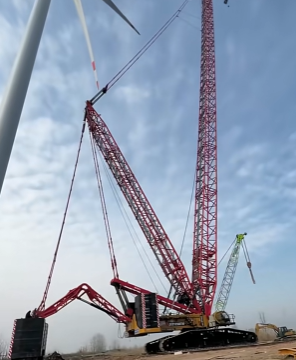
Fundamental Advantage: Extremely Low Ground Bearing Pressure, Neutralizing the Risk of Sinking
The starting point of all adaptability for this crane lies in the balance between force and area. Ground bearing pressure, the pressure exerted by the equipment per unit area on the ground, is the key indicator determining whether it will sink into soft soil:
Principle Analysis: Unlike wheeled cranes that rely on limited tire contact area, the weight and load of a crawler crane are evenly distributed over the total area of its two wide tracks. Its massive ground contact area is akin to fitting the crane with a pair of "snowshoes."
Data Comparison: The ground bearing pressure of a large crawler crane can typically be as low as 0.05-0.1 MPa (approximately 0.5-1 kg/cm²), which is only equivalent to the pressure exerted by an adult human foot on the ground. In contrast, the localized ground bearing pressure of the tires on a wheeled crane of similar tonnage can be several MPa, tens or even hundreds of times higher.
Direct Effect: Extremely low ground bearing pressure means the tracks penetrate only shallowly into the ground particles. This allows the crawler crane to quickly establish a solid, stable working platform even on weak-bearing surfaces like mud and sand, avoiding the risks of tipping and deep sinking.
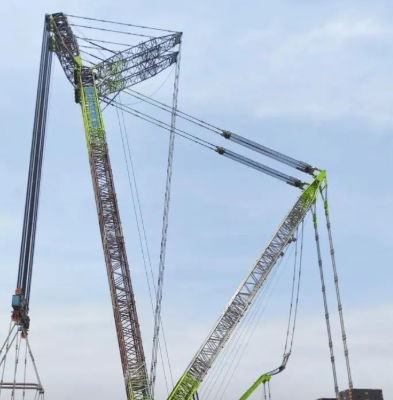
Dynamic Performance: Superior Traction and Site Mobility
After solving the problem of static stability, moving and repositioning within a muddy site is another major challenge for any crane. The crawler crane also excels in this aspect due to its design:
Continuous Traction: The track makes continuous linear and areal contact with the ground, providing far superior adhesion and traction compared to tires. This effectively prevents spinning and slipping, even on wet, muddy terrain, which is critical for a crane's mobility.
Independent, Powerful Drive: Each track is driven by an independent hydraulic motor, delivering massive torque. This enables on-the-spot turning, slow and precise load-and-carry movements, and easy traversal of common site depressions and small obstacles.
Reduced Site Dependency: This powerful mobility lessens the stringent requirement for site access road hardening. It allows the crawler crane to move directly into the core work area, enhancing overall construction efficiency where other cranes might falter.
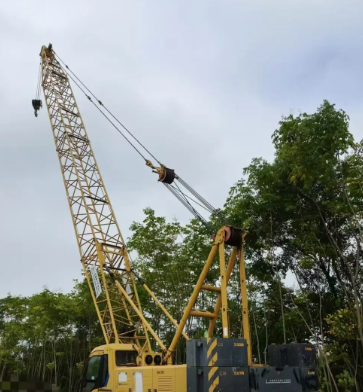
Comprehensive Value: Unparalleled Operational Stability and Economic Benefit
The first two major advantages ultimately converge at one point: enabling safe and efficient heavy lifting operations under extreme conditions. This is where the crawler crane provides unmatched value:
Exceptional Anti-Tip Stability: Crawler cranes have a heavy chassis and a low center of gravity, combined with a wide track gauge, forming an extremely stable support structure. Coupled with their low ground bearing pressure, this gives the crane stronger anti-tipping capability when lifting tall, large, or heavy loads, especially on muddy ground prone to uneven settlement.
Site Protection and Cost Reduction: Their minimal ground pressure means negligible damage to the original site surface. This not only protects the environment but directly saves significant costs and time associated with laying steel plate roads or reinforcing foundations, offering clear economic benefits for projects utilizing a crawler crane.
All-Weather Adaptability: Whether dealing with mud pits after heavy rain, thawing frozen ground, or soft sandy beaches, the crawler crane can provide reliable operational capability through its systemic design, making it a truly all-weather crane and engineering asset.
Conclusion
In summary, the dominance of the crawler crane in muddy sites is not due to the improvement of a single feature but stems from a systematic design philosophy. It fundamentally redefines the interaction between heavy machinery and soft ground through low ground bearing pressure. Its tracked undercarriage provides this crane with unmatched traction and mobility. Ultimately, the crawler crane integrates all advantages into unparalleled operational stability and comprehensive economic efficiency. At the engineering frontiers where the limits of nature are challenged, this type of crane, with its steady pace, proves itself to be not only the powerhouse within the crane family but also a solid fulcrum for humanity to build civilization upon complex foundations.