
Twin-Hoist Overhead Bridge Crane: Core Applications and Value Analysis
In modern industrial logistics and production systems, the crane is an indispensable key piece of equipment. Among them, the overhead bridge crane serves as the backbone lifting and handling power over workshop floors. With its stable structure and efficient operating range, it is widely used across various industries. The twin-hoist overhead bridge crane, as a significant functionally enhanced model, further solves complex lifting challenges through its unique dual-lifting mechanism design, making it a powerful tool for improving efficiency and process flexibility.
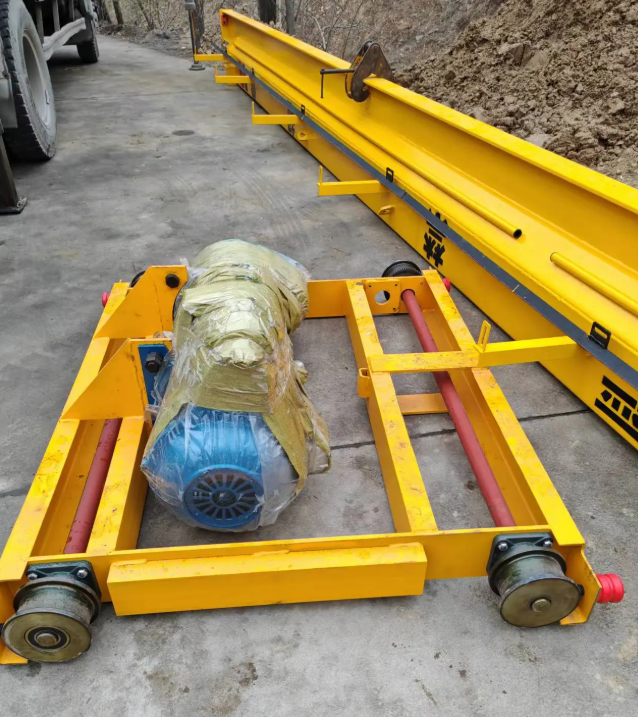
Core Definitions: From Basic to Enhanced
Crane: A general term for any mechanical device capable of lifting and horizontally moving materials; it is the "lifting giant" of modern industry.
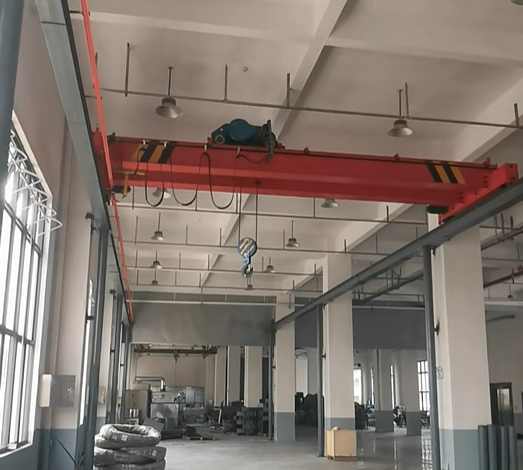
Overhead Bridge Crane: Specifically refers to a bridge-structured crane that spans rails on both sides of a workshop or warehouse. It consists of a bridge girder, a trolley, and a hoisting mechanism, enabling material handling within a three-dimensional rectangular space.
Twin-Hoist Overhead Bridge Crane: This is an advanced model based on the standard overhead bridge crane, equipped with two independent or synchronized hoisting mechanisms (the "hoists") on the same trolley. This represents not just a quantitative addition but a qualitative change in operational modes.
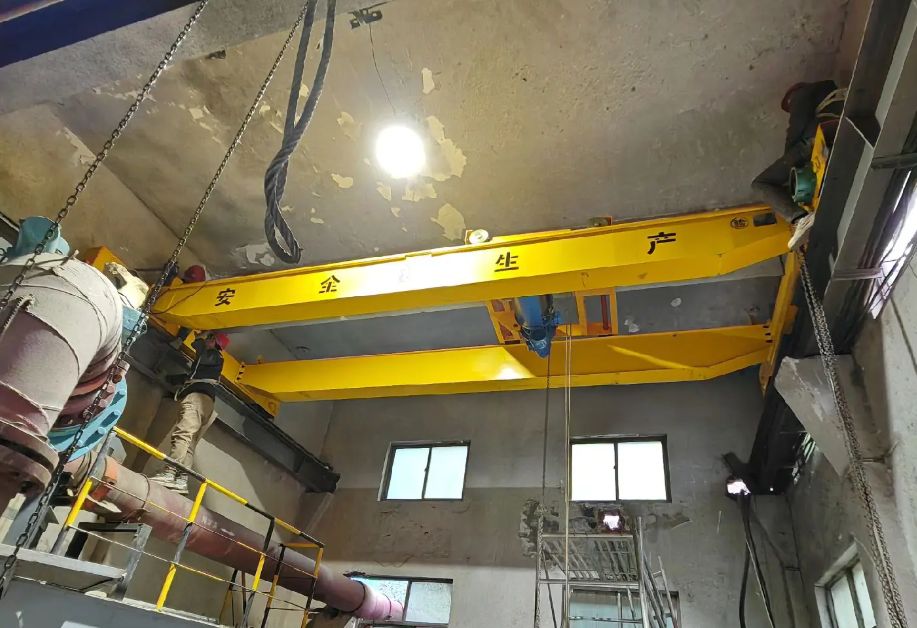
Core Advantages: Why Choose a Twin-Hoist?
Compared to a traditional single-hook overhead bridge crane, the core advantages of the twin-hoist overhead bridge crane are:
Collaborative Operation Capability: Two lifting points can work in coordination to perform complex maneuvers impossible for a single crane.
Multiplied Operational Efficiency: Can lift two loads simultaneously or alternately, significantly reducing equipment idle and waiting time.
More Stable and Safer Lifting: For long, large, or irregular workpieces, two-point lifting effectively distributes force, preventing deformation and swing.
Spatial and Process Flexibility: Can serve two adjacent workstations, optimizing workshop space utilization and adapting to special process flows.
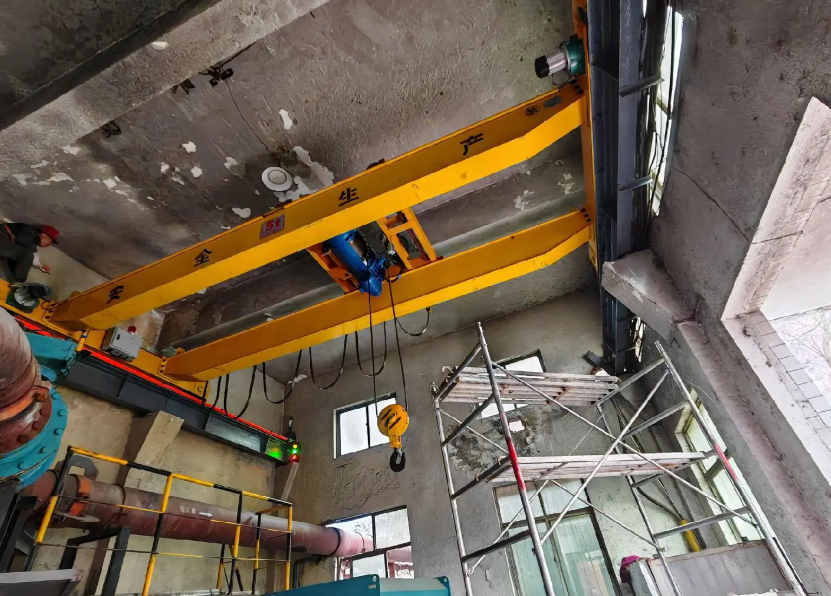
Key Application Scenarios
Leveraging these advantages, the twin-hoist overhead bridge crane excels in the following scenarios:
Precision Assembly and Turning of Large Components
Scenario: Manufacturing workshops for heavy machinery, wind power equipment, large pressure vessels, ship sections.
Application: Using the two hooks to lift specific points of the workpiece, precise synchronous or differential control allows for easy aerial posture adjustment, level holding, and 360-degree turning of components, greatly improving assembly accuracy and safety.
High-Efficiency Material Transfer and Stacking
Scenario: Steel yards, logistics warehouses, precast component yards, raw material workshops.
Application: Can simultaneously lift two bundles of steel, two packages of goods, or two standard containers, nearly doubling efficiency. Particularly suitable for the stable handling of long materials (e.g., pipes, profiles), avoiding bending caused by single-point lifting.
Production Line and Special Process Coordination
Scenario: Automated production lines, processing workshops with multiple parallel processes.
Application: One twin-hoist overhead bridge crane can act like a "relay hand," with one hook taking material from Line A while the other simultaneously places material on Line B, enabling seamless and rapid material flow between different production lines or processes.
Space-Constrained or Balance-Critical Lifting Situations
Scenario: Workshops with compact space, or lifting tasks where the workpiece's center of gravity is difficult to locate.
Application: The twin-hoist design itself provides a natural balancing solution, enabling complex lifts within limited space and reducing absolute reliance on a single crane for vast workshop span and height.
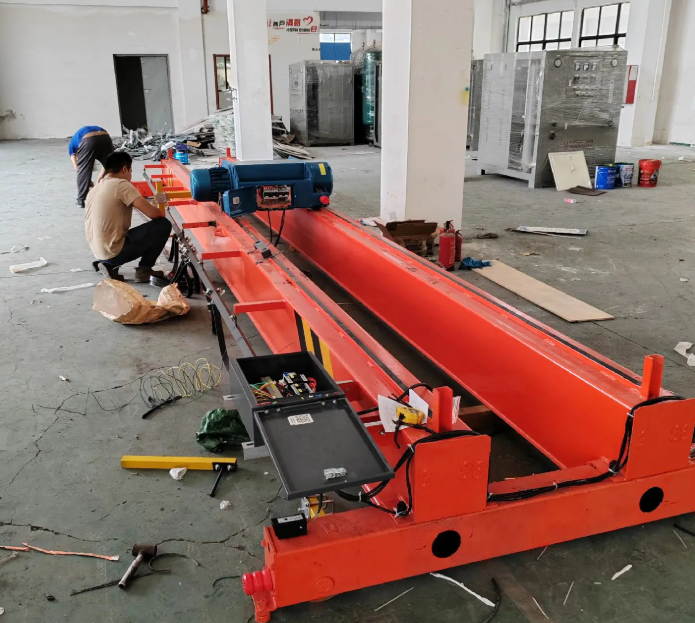
Technological Evolution and Industry Significance
The evolution of the overhead bridge crane, from manual to intelligent, from single-hook to multi-hoist, reflects the demands of industrial development.
The twin-hoist overhead bridge crane is a key milestone in this evolution. It is not merely simple equipment duplication but represents the trend towards intelligent and flexible development in crane technology. By integrating advanced synchronous control, anti-sway technology, and IoT systems, it has evolved into a key intelligent node within smart factory logistics systems.
Conclusion
In summary, the twin-hoist overhead bridge crane addresses the core demands of modern industry for high efficiency, high precision, and high flexibility in lifting operations by enhancing the capabilities of the classic overhead bridge crane. It is essential equipment for achieving productivity upgrades and process innovation in fields like heavy manufacturing and logistics warehousing, fully demonstrating the core value of an advanced crane in enhancing overall production efficiency.