
In modern ports, railway yards, and major construction sites, the gantry crane is a pivotal piece of equipment. As a highly specialized type of crane, its defining bridge-and-leg structure allows it to span wide work areas, making it exceptionally efficient for handling heavy loads. The entire lifecycle performance and safety of this crane depend critically on the quality of its initial mechanical installation. Every phase of this installation process must be executed with precision, as it forms the very foundation upon which the gantry crane operates. This article details the essential steps for the successful mechanical installation of a gantry crane, providing a guide for achieving a robust and reliable set up.

Establishing a Solid Base: Foundation and Support Structure
The installation of any large crane begins with creating a stable and level base. For a gantry crane, this involves meticulous work on the running tracks and the support legs:
Track Installation: The tracks provide the dedicated pathway for the gantry crane's travel. Precise control over gauge, elevation, and parallelism is non-negotiable. Proper installation ensures smooth travel, minimizes wear, and prevents hazardous "rail gnawing." The track bed and fastenings must be robust, as they bear the full weight and dynamic forces of the moving crane.
Leg Installation: The legs transfer the entire load of the crane to the tracks and foundation. During installation, achieving perfect vertical alignment and ensuring the diagonal measurements between legs are identical is crucial. This step guarantees structural integrity and stability, which are fundamental requirements for all types of crane structures, especially one as large as a gantry crane.

Assembling the Primary Structure: Main Girder and Framework
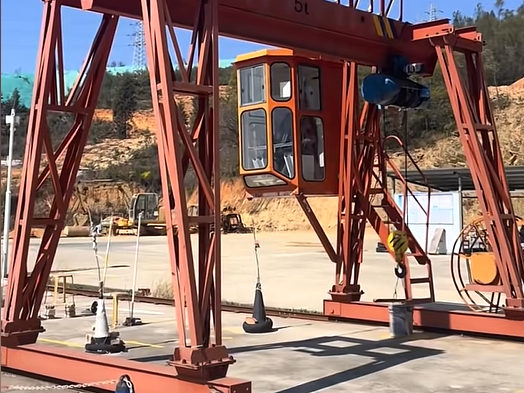
The main girder is the backbone of the gantry crane. Its correct installation is vital for the structural rigidity and long-term performance of the crane equipment.
Hoisting and Joining: Erecting the main girder, often in sections, requires careful planning. Lifting points must be calculated to prevent deformation. When connecting the girder to the end carriages on the legs, flange surfaces must mate perfectly, and high-strength bolts must be torqued in a specific sequence. This ensures the crane's framework acts as a single, unified load-bearing unit.
Geometric Control: To counteract deflection under load, the girder is built with a predefined upward camber. Verifying this camber during installation is essential. Simultaneously, the horizontal straightness (sweep) of the girder must be checked to provide a true path for the crane’s trolley. Proper geometric control distinguishes a professionally installed gantry crane from one that may face operational issues.
Fitting the Moving Components: Trolley and Hoisting Unit
The trolley and hoist are the workhorses of the gantry crane, directly responsible for the precise and safe movement of loads on this type of crane. Their installation focuses on the alignment and smooth operation critical to any crane's performance.
Trolley Installation: Once placed on the girder tracks, the trolley's wheels require fine adjustment. Correct alignment prevents scrubbing, reduces wear, and ensures all wheels share the load evenly. A well-installed trolley is key to the smooth travel expected from any high-performance crane.
Hoisting Mechanism Installation: This system, comprising the motor, gearbox, drum, and brakes, demands precise alignment. The wire rope must wind onto the drum correctly to avoid damage. The brake system must be adjusted for immediate and reliable response. The installation of this mechanism is a critical safety and performance step for the hoisting system of any crane, particularly a heavy-duty gantry crane.

Final Integration: Safety Systems and Commissioning
The final stage of installation involves integrating the crane's safety systems and thoroughly testing the complete machine as a unified system.
Safety Device Installation: A gantry crane, like all modern industrial crane equipment, must be equipped with mandatory safety devices. These include travel limit switches, overload protection, height limiters, and wind-resistant devices like rail clamps. Each device must be installed correctly, calibrated, and tested. This is not just a regulatory step but a fundamental ethical and technical practice in crane installation.
Testing and Commissioning: Comprehensive testing is the ultimate validation of the installation and the crane's integrity. This includes no-load, static (to 1.25x rated capacity), and dynamic load tests. All crane functions are verified, structural deflection is measured, and every safety device is proven operational. Only after passing these tests can the gantry crane be considered safely and properly installed, ready for handover and productive service as a reliable piece of crane equipment.
Conclusion
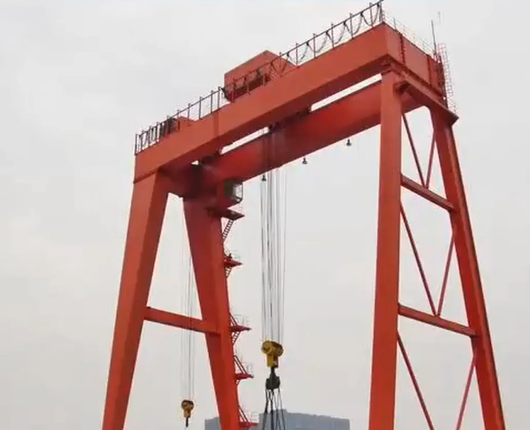
In conclusion, the mechanical installation of a gantry crane is a complex, multi-stage engineering undertaking. It demands a disciplined approach to precision, alignment, and safety at every step. From its foundations to its highest point, the quality of the installation dictates the reliability, safety, and longevity of the crane. For a machine as critical as a gantry crane, professional installation is not merely a procedure—it is the cornerstone of its future service, ensuring it operates as a model of strength and stability for years to come.